Coverage note
Kubernetes penetration testing: clusters, identity and the quiet privilege
Kubernetes penetration testing asks what a single compromised workload could reach. So it looks at cluster permissions, workload identity and the cloud roles behind them, rather than at each container alone.
- Manual exploit chains
- PTES and the OWASP testing guide
- Authorised scope only
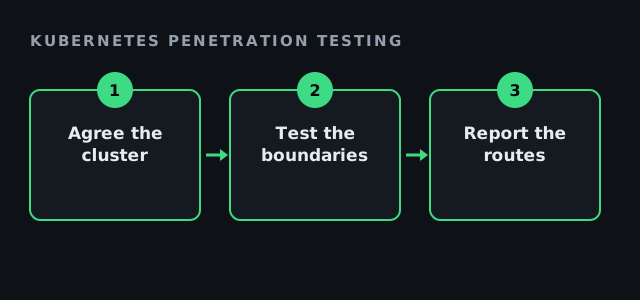
What Kubernetes penetration testing covers
Clusters accumulate permissions over time, and few teams review them all. Therefore the scope usually includes the following, agreed in writing first:
- Role-based access and service accounts
- Network policy between namespaces
- Secrets handling inside the cluster
- The trust between the cluster and its cloud account
How Kubernetes penetration testing starts
Most engagements begin from an agreed position, for example a test workload in one namespace. So the question becomes how far that position reaches. Also, a configuration review against the CISA and NSA Kubernetes Hardening Guide can run alongside.
| Starting point | What it simulates | Agreed in writing |
|---|---|---|
| Test workload | A compromised application. | Namespace and removal date. |
| Developer credential | A leaked kubeconfig. | Permissions and monitoring. |
| Configuration review | An audit of the settings. | Read-only access. |
Before Kubernetes penetration testing
Tick what is true. Open items are settled in the written scope.
Your result appears here as you tick, so you can see what is still open.
Keeping Kubernetes penetration testing safe
Production clusters carry real traffic, so the rules matter. Therefore testing windows, excluded workloads and a stop procedure are signed before any work. In addition, every test workload is removed at the end, and each action is logged with a timestamp.
What the cluster report shows
You receive each route with evidence, written by the penetration hacker who found it. Then fixes are ranked by how much they reduce reach, because a single over-scoped role often closes a whole chain. The retest is included.
Fees and fit
Full engagements run from $35,000 to $120,000, while the floor is $25,000. Also, the bounded Attack Surface Diagnostic starts at $4,500. Moreover, its fee is credited in full against a full engagement commissioned within ninety days. Cluster work is usually scoped as part of a cloud engagement, so the fee reflects the whole estate.
Kubernetes penetration testing questions
Is Kubernetes penetration testing safe on production?
With agreed windows, exclusions and a stop procedure, yes. A staging cluster is also an option.
Does managed Kubernetes need provider approval?
Your own configuration is yours to authorise. The provider's testing policy is checked in the scope.
How is Kubernetes penetration testing priced?
As one fixed fee, usually inside a wider cloud engagement.
Is a configuration scan enough?
A scan lists settings. However, a test shows which of them actually connect.
Related guides
Brief us on your clusters
Describe the clusters, the cloud behind them and what you most want to protect. The penetration hacker who would lead the work replies with a written scope and one fixed fee.
Send the brief