A penetration hacker breaks what other firms only scan
Breakpoint Labs is a manual testing practice. A penetration hacker on our team chains small findings into proven business impact, because that is the only way to show what an attacker would really do with your estate.
$ enum --target ████████████
47 hosts, 12 services, 3 forgotten subdomains
$ chain --from ci-runner --to identity
[+] token in public job log
[+] role assumed → ██████
[+] secret read → backup operator
[!] domain administrator @ t+41h
scanner findings on this path: 0
What a penetration hacker does that a scanner cannot
Automated tools are useful, but they grade findings one at a time. A penetration hacker does not, and neither does an attacker. Therefore the gap between a scan and a real test is the gap between a list and a proof.
Automated scan
Finds items
- Rates each issue in isolation, so a chain of three low findings scores as low.
- Cannot reason about your business logic, because it does not know what the app is for.
- Produces false positives your engineers then spend a week disproving.
- Proves nothing, since it never demonstrates actual impact.
Manual engagement
Proves impact
- A penetration hacker links findings into a path, so you see the route rather than the parts.
- Abuses logic a tool cannot model, for example an approval step that trusts a client value.
- A penetration hacker validates every finding by hand, therefore the report contains no noise.
- Ends with reproducible evidence, so remediation can be verified.
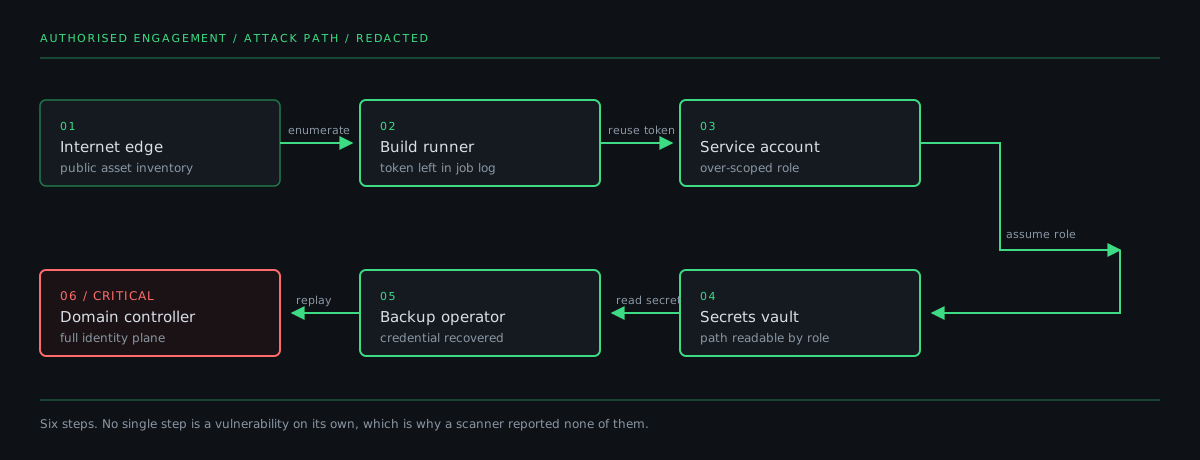
That is a real chain from an authorised engagement, redacted. Not one of those six steps is a vulnerability on its own. As a result the automated scan that ran the week before reported none of them.
The phases behind every penetration hacker engagement
Every penetration hacker here follows the Penetration Testing Execution Standard and the OWASP testing guide, because a named methodology is what makes an engagement repeatable. Each phase below is manual-led where it matters.
- pre-engagementPhase 01
- Scope and authorisationWe agree the target list, the permitted techniques, the testing windows, and the escalation path. The system owner signs it, and nothing starts before that signature exists.
- intelligencePhase 02
- ReconnaissancePublic asset discovery, subdomain and service enumeration, credential exposure, and supply-chain surface. Most engagements find something the asset owner had forgotten was still reachable.
- threat-modelPhase 03
- ModellingWe rank the paths an attacker would actually take against your business, so effort goes where the impact is rather than where the tooling is easiest.
- exploitationPhase 04
- ChainingThe penetration hacker combines findings and proves them. Each step is documented with the request, the response, and the artefact, therefore your engineers can reproduce it without guessing.
- post-exploitPhase 05
- Impact and cleanupWe establish what an attacker could reach, then remove every artefact we placed. In addition we log each action with a timestamp for your incident team.
- reportingPhase 06
- Report, debrief, retestFindings, business risk, and prioritised remediation, written by the penetration hacker who ran it. Once you have applied the fixes, the retest is included.
What a penetration hacker tests here
Scope is always agreed in writing first. These are the surfaces a penetration hacker usually covers here, although we shape each one around your threat model.
A penetration hacker finding, end to end
Client names stay confidential, so we publish the shape of a penetration hacker engagement instead. Below is finding four from an authorised retail engagement, exactly as the structure reaches the client.
Build runner token permits assumption of an over-scoped role,
which in turn reads a vault path holding backup operator credentials.
## reproduction
1. retrieve token from public job log at ████████████
2. assume role ██████████ using that token
3. read secret at ████████
4. authenticate as backup operator
5. replay to domain controller
## business impact
Full control of the production identity plane.
## remediation
[1] scope the runner role to the artefact bucket only
[2] rotate the exposed token and enable log redaction
[3] remove backup operator from the vault path policy
verified on retest, zero downtime
Penetration hacker fees and scope
Where a full penetration hacker engagement usually lands. The floor for a full engagement is $25,000, while red team work begins higher.
We quote one fixed number after a written technical brief, so there is no hourly billing and no change orders mid-project. Moreover, the full engagement is not the only door, because the bounded diagnostic below is a different piece of work rather than a thinner one.
A bounded penetration hacker diagnostic
from $4,500 Second doorThe Attack Surface Diagnostic is a bounded review of what you expose to the internet. We map your public estate, test it, and verify every finding by hand rather than sending you a scanner export. Scope is fixed at up to five external hosts and one public web application. Your report then arrives within five business days.
Suited to
- An enterprise customer, an insurer or an investor has asked for evidence of testing, and you have a date to meet.
- Nothing external has ever been tested, so you first need to know what is actually reachable.
- You would rather see how we work on something small before committing to a full programme.
Not this engagement
- Internal network, Active Directory or cloud role review.
- Business logic testing, or work that reads your source code.
- Full exploitation chains against a defended estate.
- Auditor-grade evidence for SOC 2 or PCI, which needs the full engagement above.
The fee is credited in full. Commission a full engagement within ninety days of your report and the whole review fee comes off the price. Consequently the review costs you nothing if you go on to the deeper work.
This is a different engagement, not a smaller version of the one above. Moreover, it is priced by scope rather than by depth of care. Consequently, where the review finds something that needs the deeper work, we say so plainly and quote it separately.
Authorisation is the whole line
Every penetration hacker technique on this page is lawful only when the system owner has authorised it in writing. Without that document the same actions are a criminal offence, and in the United Kingdom that holds regardless of intent.
- We do not access any account, device or system without documented consent.
- Nor do we monitor individuals, or recover accounts that are not yours.
- We do not trace or retaliate against an attacker. Report that to law enforcement.
Questions about hiring a penetration hacker
What is a penetration hacker?
A penetration hacker is a plain-language name for an authorised penetration tester. The role is to attack a system with the owner's written permission, prove what a real intruder could reach, and hand back the evidence and the fix. The permission is what separates the job from a crime.
How does a penetration hacker differ from a vulnerability scan?
A scan lists issues one by one, while a penetration hacker links them. Because attackers combine small weaknesses, the chain is usually far more serious than any single item in it. A penetration hacker also validates every finding by hand, so the report carries no false positives.
Do you need credentials or access to our systems?
It depends on the goal. Black-box work starts with nothing, although grey-box testing with a low-privilege account usually finds more for the same budget. We agree that in the written brief and record it in the rules of engagement.
Will testing break production?
Your penetration hacker agrees testing windows, blast-radius limits and an escalation contact before starting. Destructive techniques are excluded unless you explicitly ask for them in writing. In addition, we log every action so your team can correlate anything they see.
What does a penetration hacker cost?
A full penetration hacker engagement starts at $25,000, and most land between $35,000 and $120,000. Alternatively, the bounded Attack Surface Diagnostic starts at $4,500 across five external hosts and one web application. Both fees are fixed after the scoping brief, therefore neither moves during the project. Moreover, the diagnostic fee is credited in full against a full engagement commissioned within ninety days.
What do we receive at the end?
A findings report with reproducible chains, a business risk summary, prioritised remediation, a written debrief from the penetration hacker who ran it, and a retest once your fixes are in. Evidence is destroyed after delivery.
Coverage
Where a penetration hacker looks, surface by surface
Each note covers one attack surface at a high level: scope, authorisation and what the report shows.
- Internal penetration testing
- DevOps penetration testing
- Kubernetes penetration testing
- IoT penetration testing
- OT penetration testing
- Physical penetration testing
- Microservices penetration testing
- Citrix penetration testing
- VoIP penetration testing
- Firewall penetration testing
- Blockchain penetration testing