Coverage note
Microservices penetration testing: where trust between services breaks
Microservices penetration testing looks at how services trust each other, not just at the public edge. So it finds paths where one weak service opens the rest.
- Manual exploit chains
- PTES and the OWASP testing guide
- Authorised scope only
Why microservices penetration testing matters
A microservice estate has many internal doors. However, teams often secure the gateway carefully and treat internal calls as trusted. Therefore a foothold in one service can travel further than anyone expects.
Ownership is spread across teams too. Also, each service may use a different framework, so controls vary from one to the next.
What microservices penetration testing covers
The test follows requests from the edge to the data. For example, whether a low-privilege service can call an administrative one.
- Authentication between services
- Authorisation at each service, not only the gateway
- API gateway and routing rules
- Service identity and secrets handling
- Message queues and event consumers
Microservices penetration testing readiness check
Tick what is already true. Open items go into the written rules of engagement.
Your result appears here as you tick, so you can see what is still open.
Scoping microservices penetration testing
Architecture diagrams drive scope. However, the real call graph often differs from the diagram.
| Question | Effect on scope |
|---|---|
| How many services? | More services, more paths |
| Service mesh in use? | Mesh policy is reviewed |
| Event-driven parts? | Queues add surfaces |
| Shared or separate data stores? | Shared stores widen impact |
Authorisation and safety
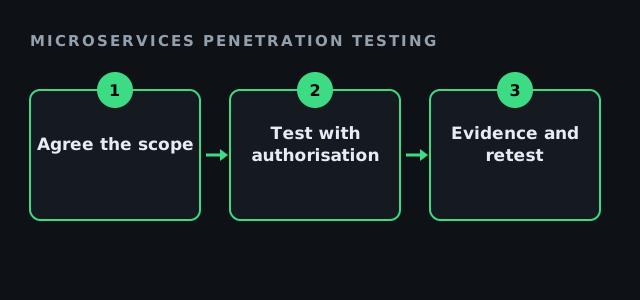
Testing runs only under written rules of engagement, agreed before day one. Also, a staging environment is preferred, because internal calls can change data.
In addition, the team agrees a stop contact. As a result, any unexpected effect is halted at once.
Evidence, fees and retest
Findings come back with evidence your engineers can reproduce. The OWASP Microservices Security Cheat Sheet frames common fixes.
Full engagements run from $35,000 to $120,000, while the floor is $25,000. Also, the bounded Attack Surface Diagnostic starts at $4,500. Moreover, its fee is credited in full against a full engagement commissioned within ninety days.
Also keep the service map current. So the next test starts from facts.
Microservices penetration testing questions
Is microservices penetration testing different from API testing?
It includes API testing, plus trust between internal services.
Does microservices penetration testing need source code?
Not always, but architecture detail makes it more efficient.
Can microservices penetration testing run in production?
It can, but staging is safer for internal calls.
Who leads the work?
A senior penetration hacker, who also writes the report.
Related guides
Send the brief for microservices penetration testing
Describe the services and how they talk to each other. The penetration hacker who would lead the work replies with a written scope and one fixed fee.
Send the brief